Wednesday, September 7, 2011

A. Jase Jones, part 2: Seminary Student; Pastor; Home Missionary; and Chaplain

(I originally posted this on the TBMaston Foundation blog, Weighty Matters, on June 21, 2011. Last Friday, September 2, would have been Daddy's 98th birthday.)


Mother & Daddy with our kids, Alison & Travis (1991)

Daddy began study at Southwestern Seminary, but his study was interrupted when, in early 1943, he enlisted in the U. S. Army as a chaplain. For the next 2 years, he served under General George S. Patton's command in the European Theatre of Operations.

In the summer of 1945, after victory in Europe was achieved, his regiment returned home on the Queen Mary. They were expecting only a brief stay at home, for they were scheduled to ship out for the Pacific in the fall. Only Harry Truman's decisive actions, leading to Japan's surrender, changed those plans, meaning Daddy was home to stay.

He soon resumed his seminary work while pastoring small churches. He received his Master's degree from Southwestern in 1948 and decided to pursue a doctorate in theology, with a major in Christian Ethics under T. B. Maston.

In fact, my connection with Dr. Maston goes back to my birth. Daddy was scheduled to take his spring 1951 oral exam on March 16, but Mother was expecting, and the due date was right around the time of his exam. Although he was studying diligently (while also carrying out his pastoral responsibilities and working a part-time job with Foremost Dairy), his mind was preoccupied with taking care of Mother and preparing for the birth of their second child. So he requested an extension from Dr. Maston, and Dr. Maston granted him an extra month, rescheduling the exam for April 16. I was born on March 14.

Daddy received his Th.D. in Christian Ethics from Southwestern Seminary in 1956, just months before his 43rd birthday.

He continued pastoring small Texas churches until January 1957, when he began work with the SBC Home Mission Board. His work was co-sponsored by the Dallas and Tarrant Baptist Associations, and – for a time – by the Baptist General Convention of Texas. He had offices at both the Dallas and Tarrant Baptist Associations.

At that time, the department was known as the Department of Jewish Evangelism. He began studying the Jewish culture, the Jewish faith, and the Jewish people, and he developed a special lifelong love of - and admiration for - the Jewish people. In fact, in 1973 he and Mother spent a 6-month sabbatical in Israel, where he studied at the Institute of Holy Land Studies, and he obtained a working knowledge of the Hebrew language.

In 1962, we moved to Kansas City. He was still with the Home Mission Board, but his work was now co-sponsored by the Kansas City Baptist Association (where he had his office) and the Missouri Baptist Convention. In 1974, he and Mother moved "home" to Texas, and he spent his final 5 years with the Home Mission Board officing from their home in Marble Falls.

Through the years, in addition to his daily work as pastor and then home missionary, Daddy remained in the U. S. Army Reserves as a chaplain attached to hospital units, attending monthly meetings and performing his annual required 2 weeks of active duty (including a stint in 1963 as chaplain in the disciplinary barracks at Fort Leavenworth). Shortly before retiring from the Reserves at age 60 in 1973, he attained the rank of Colonel, an achievement of which he was especially proud.
Read part 1: Surrendered to God's Call

Read part 3: Maston Foundation; and At Home with His Family

A. Jase Jones, part 3: Maston Foundation; and At Home with His Family

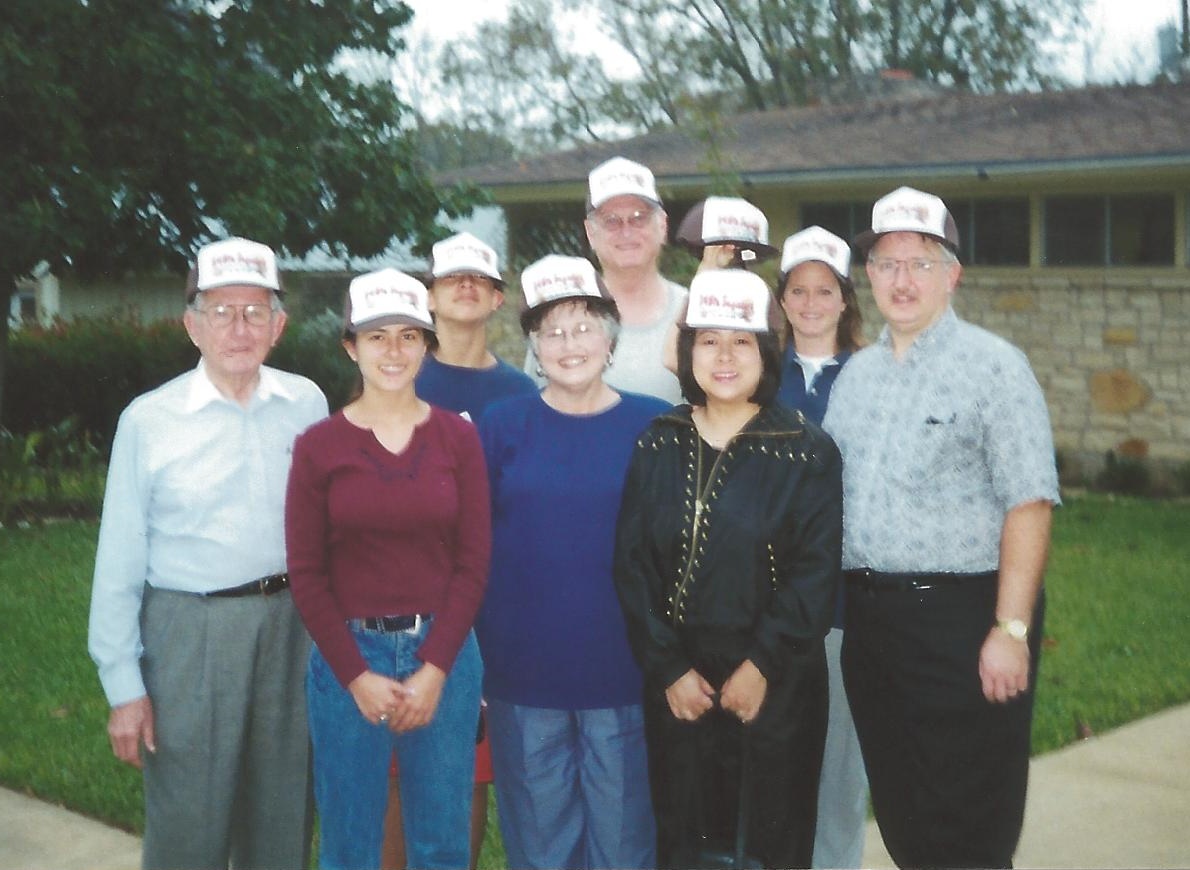
Thanksgiving 1998: We're all wearing caps commemorating the recent reunion of Daddy's WWII regiment, the 398th Engineers. (missing - Michael, Patsy & Palmer's son)

L to R: Daddy; Alison; Travis; Patsy; Palmer McCown, Patsy's husband; Joanna; Stephanie; and yours truly

Palmer is holding the cap belonging to Jim Markgraf, Stephanie's husband, who is taking the picture.

(I originally posted this on the TBMaston Foundation blog, Weighty Matters, on June 21, 2011. Last Friday, September 2, would have been Daddy's 98th birthday.)

Over the years, Dr. and Mrs. Maston and Tom Mc, their elder son, were visitors in our home on several occasions. Daddy always considered Dr. Maston his primary mentor and influence in his own ministry, but they were also close friends and stayed in touch regularly by mail and by phone.

A vision eventually began to form in Daddy's heart and mind - a vision of an entity that would keep Dr. Maston's life and teaching alive, long after Dr. Maston and his students were gone, as a legacy for generations yet unborn. When Daddy retired from the Home Mission Board at the beginning of 1979, he was able to focus more directly on this vision. He had already begun talking about the idea to some of his friends - fellow Maston students like Bill Pinson, Jimmy Allen, James Dunn, and Foy Valentine. In 1979, he flew to San Francisco and met with Bill Pinson - then president of Golden Gate Seminary - to discuss funding.

The T. B. Maston Scholarship Fund was born, ultimately becoming the TBMaston Foundation. In 1987, the Foundation held its first biennial Awards Dinner and honored Foy Valentine with the inaugural T. B. Maston Christian Ethics Award. Dr. and Mrs. Maston were in attendance. Dr. Maston died the following spring.

Daddy chaired the Foundation's Board of Trustees from its inception until 1992, after which he continued to support the work of the Foundation throughout his life. At the Foundation's 1993 Awards Dinner, the Board honored A. Jase Jones with the T. B. Maston Christian Ethics Award. I doubt that any recognition or award ever meant more to him than this one, because T. B. Maston had been the major influence in his life and ministry. In the years following, as Mother's failing health and then his own required him to step back from active involvement, Daddy remained pleased to see the vitality and work of the Maston Foundation.

I've tried to share just a little bit about Daddy's ministry - barely a nutshell view. But that doesn't even begin to tell the story of A. Jase Jones.


Father's Day reminds me of the caring Daddy who was patient and understanding when I lost my faith during my college years. He was the major influence in helping me to find my way back to Christ. Father's Day reminds me of the caring Granddaddy who doted over his grandkids - first Stephanie and Michael (Patsy's children) and then Alison and Travis (our kids), and then his great-grandchildren Jon Michael and Christopher (Stephanie's boys).

Father's Day reminds me of the loving husband who insisted on keeping Mother at home where he could personally take care of her day and night after she had become unable to care for herself. For him, the blessed marriage that lasted 59 years and ended only with her death in 1997 seemed much too short.

And last night, as I sat rocking our second grandchild, Anderson James Clements (born yesterday afternoon), in Alison's hospital room, I couldn't help but think how much Mother and Daddy would have loved Anderson and his sister, Avery Lin, if only they had lived to see them.

Above all else, they were loving parents, and Patsy and I - and our families - know how very blessed we've been. Thanks be to God.


Read part 1: Surrendered to God's Call

Read part 2: Seminary Student; Pastor; Home Missionary; and Chaplain

Wednesday, August 10, 2011

Heroes of Baptist Freedom: Bob Stephenson & Associated Baptist Press

On September 8, Associated Baptist Press (ABP) will honor Bob Stephenson with its Founders Award at a dinner at NorthHaven Baptist Church, Norman, Oklahoma, where Bob and his wife, Norma, are members. When I received the announcement, I immediately emailed David Wilkinson, ABP executive director, and congratulated ABP on making such an outstanding selection.

Bob Stephenson is a valued friend to me and everyone at TBC. He is a longtime TBC Board member and generous supporter. More than that, though, Bob Stephenson is a friend of Baptists. No one has done more to defend and promote our Baptist heritage than Bob Stephenson. Truth be told, he has been one of the driving forces of Texas Baptists Committed almost from the beginning. But his generous support and tireless activity have extended to any and every front on which Baptist principles have been under attack.

In announcing this award, ABP noted Bob's "17 years of distinguished service to ABP and his steadfast and generous support for a free and responsible press for Baptist Christians worldwide."

This is a commitment and cause that we cannot afford to overlook or diminish. A free press is essential to a free people, Baptists or otherwise. We in Texas risk taking it for granted, because we have grown accustomed to the Baptist Standard's consistent commitment to journalistic integrity and independence, under the leadership of Marv Knox. But taking it for granted is the first step toward losing it. Just ask Baptists in other states!

In the 1980s, when Paige Patterson, Paul Pressler, Adrian Rogers, and their friends were in the midst of their effort to take control of the SBC, Southern Baptists took Baptist Press for granted. It was led by two men, Dan Martin and Al Shackleford, who were dedicated to rooting out and telling the truth. But the truth is uncomfortable to some.

Associated Baptist Press was founded in response to the SBC Executive Committee's firing of Martin and Shackleford at Baptist Press, which took place only a month after the SBC annual meeting in June 1990 (Baptist Brief, March 24), at which Morris Chapman's presidential victory over Daniel Vestal had assured Fundamentalist leaders of a majority on all SBC committees and boards.

In his chapter on ABP's founding, in Walter B. Shurden's 1993 book, The Struggle for the Soul of the SBC: Moderate Responses to the Fundamentalist Movement, Stan Hastey writes, "the freedom tyrants seek first and foremost to obliterate upon assuming power is that of the press, to the end that the flow of information conveyed to the public about the new regime is controlled."

The New York Times quoted Martin as saying, ''We were fired because they want to have their own minister of information, a spin doctor who'll put the spin on stories the way they want."

Hastey goes on to write that Associated Baptist Press was born out of "the longstanding concern of several of the editors of Baptist state newspapers that the days of Baptist Press as a credible news operation were dwindling."

To learn more about ABP's beginnings, as well as the founding of TBC, CBF, and others that began as responses to the Takeover, I recommend Shurden's book. But my point here is that ABP has continued, for over 20 years, to tell the truth and provide an alternative to the Baptist Press house organ and its "spin doctors" to whom Martin referred.

As its Web site points out, ABP is "a non-profit, member-supported news organization. . . . made possible by Friends of ABP -- individuals, churches, and organizations that believe a free and unfettered source of news and information is essential to the health and integrity of the Christian witness and the Baptist movement. Contributions account for more than 86 percent of our annual operating budget."


Reporting the news "free and unfettered" isn't an easy job. Courage and unwavering commitment are required. Persistence and ingenuity are often required to overcome barriers placed in your way to discourage transparency.

For over 20 years, ABP's staff has demonstrated all of these and more. Under David Wilkinson's leadership, ABP continues to daily provide sound and comprehensive reporting of Baptist news as well as relevant national and world news, backed up by adherence to Baptist principles. If you're not subscribing to ABP's enews services, you're missing one of the best ways to stay informed about Baptist life.

Bob Stephenson "signed on" as a key supporter and co-laborer in the early days of Associated Baptist Press and has been steadfast in his support - as he has for TBC and other areas of Baptist life - from that day forward. I hope you'll make every effort to get to Norman, Oklahoma, on September 8 to honor this man who has given so much.

Reservations are required, but there is no charge for the dinner. To make your reservation today, email Beth Campbell at beth@abpnews.com, or call 1-800-340-6626, ext. 5.

Wednesday, August 3, 2011

The Debt Ceiling Food Fight and the Loss of Community

Otto von Bismarck called politics "the art of the possible." There was a time when politics brought people together to discuss their competing ideas, priorities, and agendas and find a middle ground that would serve all of their constituencies.

Oh, there was name-calling back then, too. But campaigns were largely confined to election years; with election night behind them, the victors got down to governing. Today we have the perpetual campaign, and governing has been replaced by "posturing."

By the same token, Baptists used to discuss our differences with mutual respect. We had differences in our understanding and interpretation of Scripture, as well as differences in the Scripture passages that we emphasized.

Granted, there were a few doctrines on which we believed agreement was essential. But we also agreed that the Baptist principles of soul freedom, priesthood of the believer, and local church autonomy were all derived from Scripture and that these Baptist distinctives demanded that we respect each other's right to relate to the Lord and Scripture as led by the Holy Spirit.

Our faith built community, bringing us together to worship Christ and study the Bible together, and to "do missions" together - whether those missions involved direct evangelism or humanitarian initiatives. We were united in Christ and united by our Baptist freedom.

But compromise became a dirty word in religious faith as it has in politics. Not only among Baptists but others as well.

Why?

Well, it seems to me that, in both of these arenas, many of us have decided that we have a monopoly on truth and our understanding of truth is inviolable.

In the political arena, one side insists that no new taxes be imposed, and the other side insists that there be no cuts in spending for favored programs. In the end, a deal was cut and there was compromise - but almost exclusively on one side and only because of the fear of the worldwide economic calamity that would follow a default in our nation's debt payments.


Baptists play out a similar scenario these days. One side is certain that its views are "the truth," so it digs its heels in and cries "heresy" when its claim on the truth is challenged. There is no room for compromise.

Then there's "the other side" - we who are called "Moderate Baptists" or, as one commentator put it recently, "Cooperative Baptists." We freely admit that "now we see through a glass, darkly." (the apostle Paul, in 1 Corinthians 13:12)

We state our opinions forcefully but quickly acknowledge that we don't know the mind of God perfectly. So we're willing to listen to the opinions of others. We're a community of faith, and we must depend on others in that community. One of the ways that God shapes our faith and our relationship with Him is through other Christians, but only if we stay open to new understandings.


What have largely been lost today - both in our civic life and our religious life - are humility and community, the sense that none of us has the whole truth so we must work together, listen to each other, and at times compromise for the sake of the community . . . that we're all in this together and should be cooperating for the good of the community, not just individual "constituencies."

Compromise doesn't have to mean abandoning one's principles. It might mean simply recognizing that we aren't perfect and neither are our opinions. It might mean acknowledging that sometimes what we call our "principles" are actually just our own self-interest.

Finally, it might mean - both in our civic community and our Baptist community - adding one more principle at the top of our list: respect for others who share in that community.